|
The Missile knows where it is at all times. It knows this because it knows where it isn't. By subtracting where it is from where it isn't or where it isn't from where it is (whichever is greater) it obtains a difference or deviation.
The guidance system uses deviations to generate corrective commands to drive the missile from a position where it wasn't to where it is now.
In the event that the position where it is now is not the position where it wasn't, the system has acquired a variation (variations are caused by external factors and the discussion of these factors is not considered to be within the scope of this report). The variation being the difference between where the missile is and where the missile wasn't. If variations are considered to be a significant factor, it, too, may be corrected for by the use of another system. However, for this to take place, the missile must know where it was also.
The thought process of the missile is as follows: because a variation has modified some of the information which the missile has obtained, it is not sure where it is. However, it is sure where it isn't (within reason) and it knows where it was and also where it wasn't. It now subtracts where it should be from where it wasn't (or vice versa) and by differentiating this with the algebraic difference between where it shouldn't be and where it was, it is able to obtain the difference between its deviations and its variations, which is called the ERROR SIGNAL.
Anonymous - 1959 TM-76A Guidance School

U.S. Air Force Tactical Missiles
By the Editors of this Website!
|
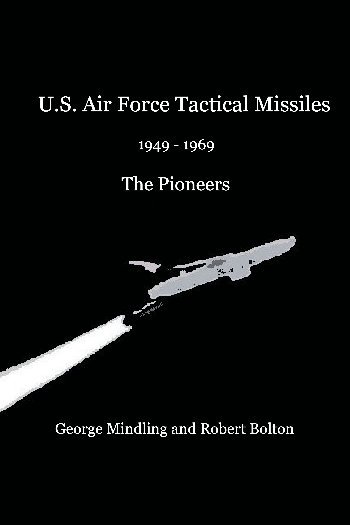
Beyond the Web Page... The only book devoted exclusively to the Matador and Mace Tactical Missiles. The book reveals the story from the initial idea that became the first U.S. pilotless bomber, through the politically troubled development of the ever evolving deployment methods of the Matador and Mace Tactical Missiles. It covers the Units, Groups, Squadrons and Wing that fielded the missiles. From the United States test sites, Europe, Asia and North Africa nothing is omitted. All phases of the application of these two missiles by the U.S. Air Force (and West German Luftwaffe) are included, from the first tentative launches of the XSSM-A-1 Matador in January 1949, to the tense alert duty of the Cuban Missile Crisis, and the final launch of a MQM13A in May of 1977. The maintenance, logistics and launch, the men, equipment and tactics are all there.
|
|
"Bob, George, I finished your book 2 days after I received it. Couldn't put it down. It was incredible reading and incredibly detailed information."
Kent Washburn (KWASH55@aol.com) Mace B, Kadena, Okinawa
"George and Bob. I want you both to know how much I enjoyed reading and how much I admire and appreciate what you have accomplished in developing and publishing "The Pioneers". It is truly an outstanding piece of work, reflecting the time and effort required to produce it, but is also a formidable contribution to our military history. I mentioned in some earlier correspondence that I was a little disappointed in the relatively small amount of information regarding the Operating Location/Guidance Sites but you largely made up for it with this magnificent book."
Dale Lake (daleflake@yahoo.com) 601st Tactical Control Squadron, 38th TMW, Hamm, Germany
"I just finished your book, The Pioneers, et al. Please accept my "job well done!" Not only is it informative, but it's very readable. I'd also like to complement you on how well you footnoted it. You have shown that a scholarly work can be both instructive and enjoyable."
Michael Roof (lavinaschnur@hotmail.com) SGM USA (Ret.)
|
ISBN 978-0-557-00029-6
"Very good work with great detail."
Col. Charlie Simpson, USAF, Retired
Executive Director
Association of Air Force Missileers
"George, the book arrived on Tuesday while I was off to France. Of course, I quickly read the chapter about Germany's quiet step into the realm of nuclear armament. You know, this is still a widely ignored fact over here...
...For me it is fascinating to see what the picture really was in the 1950s and 1960s as opposed to what the official communication of the time wanted people to believe. A fascinating book shedding some light on the early days of tactical nuclear missiles as well as the political background that even today is still largely hidden behind the propaganda of the time. Can't wait to read the rest of it."
Burkhard Domke
Harsefeld, Germany
|
"I have your excellent book on USAF tactical missiles. I actually witnessed the decommissioning of the Maces at Wüscheim back in 1966."
Paul Offen
Talitha, Tye Common Road
Billericay
Essex CM12 9PX
UK
"I just wanted to drop you a line and tell you how much I enjoyed the book that you and Bob wrote. The history was of particluar interest to me and my brother who was a history Professor at the University of Wisconsin. He also thought the book was well written, and he now knows what his little brother, (me), did while in Germany for three years."
George Joseph Snyder (gjsnyder@lanset.com)
71st TMS, Steinborn, Germany
"...by the way, I read your book, it was great, thanks for writing it."
Hack Hunton (hack@sstelco.com) Mace B, Kadena, Okinawa
|
|
US Air Force Tactical Missiles
©2008 - George Mindling and Robert Bolton |
|
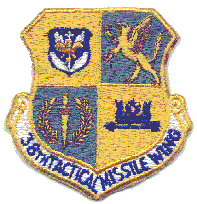
Inspired by the 38th TMW Website, George Mindling and Robert Bolton co-authored US Air Force Tactical Missiles 1949 - 1969: The Pioneers© 2008, the story of America's first operational missiles, from the Matador to the Mace, from Taiwan, Korea, and Okinawa to Germany, including Lowry, Orlando, Holloman, Santa Rosa Island at Eglin, and even Camp Happiness!
|
|
Dieses Buch ist ein Muss für alle, die im Rahmen ihres Dienstes bei der U.S. Air Force mit den frühen Marschflugkörpern
zu tun hatten, aber auch für deutsche Militärarchäologen, die in der Eifel, im Hunsrück oder im Pfälzer Wald schon
über rätselhafte Hinterlassenschaften gestolpert sind. Nach mehr als 40 Jahren wird endlich eine Fälle von Fakten,
Informationen und Geschichten zu den zwischen 1954 und 1969 in Deutschland stationierten, mit Automwaffen ausgerüsteten
amerikanischen Matador und Mace auf den Tisch gelegt.
Ausfährlich und lebendig erzählen George Mindling und Bob Bolton von den jungen Missilemen, die im März 1954 erstmals in Bitburg ankamen -
noch ganz grün im Gesicht, weil auf dem Atlantik schwerer Sturm geherrscht hatte. Von den T-33-Flugzeugen, die aus übungsgründen so taten, als
wären sie Matador-Flugkörper, äber die Startstellungen hinweg in Richtung deutsch-deutsche Grenze donnerten und sich von der Gegenseite
nur nicht erwischen lassen durften. Oder von der Kuba-Krise, als die US Air Force Europe auf DEFCON 3 ging und an die Mechaniker in
Bitburg Munition für ihre Karabiner ausgegeben wurde.
Augenzeugen sagen dazu: "Wir hätten die Vögel auf jeden Fall innerhalb von 15 Minuten in der Luft
haben müssen!" Es ist lebendige Militärgeschichte, die nun nicht der Vergessenheit anheimfällt, sondern
jedermann zugänglich wird - auch für die ortsansässige Bevökerung, die heute endlich erführt, was sich damals
in ihrer Nachbarschaft zugetragen hat. Den beiden Autoren gebührt der Dank.
Klaus Stark (klaus_stark@t-online.de)
Berlin, Germany
This book is not only a must for all those who served in the U.S. Air Force with the early cruise missiles, but also for German military archeologists who have been puzzling over relics stumbled across in the Eifel, the Hunsrück and the Palatinate Forests. After more than 40 years, we finally have a wealth of facts, information and stories, from 1954 to 1969, of the nuclear equipped American Matador and Mace missiles stationed in Germany placed on the table.
With detailed and vivid descriptions, George Mindling and Bob Bolton talk about the young Missilemen who arrived for the first time in March, 1954, in Bitburg - still green in the face, having prevailed the Atlantic crossing in major storm. Of the T-33 aircraft which practiced as if they Matador missiles launched in the direction of German-German border, or from the Cuban missile crisis, when the U.S. Air Force Europe went on DEFCON 3 and was issued ammunition to the mechanics in Bitburg for their rifles. Eyewitnesses say: "We would have to have the birds in the air in any event within 15 minutes!"
It is vital military history that is prey to oblivion, but is now accessible to everyone - even for the local population, which today finally learns what happened at that time in their neighborhood.
The two authors deserve thanks for saving the history.
Klaus Stark,
klaus_stark@t-online.de
Berlin, Germany
|
|
This page is in no way sponsored or endorsed by the United States Air Force.
Opinions and views expressed are those of the author and not necessarily those of the
Department of the Air Force.
|
Web Page Design and Development by
George Mindling - Port Charlotte, Florida
© George Mindling - 2003-2006 All Rights Reserved
|